
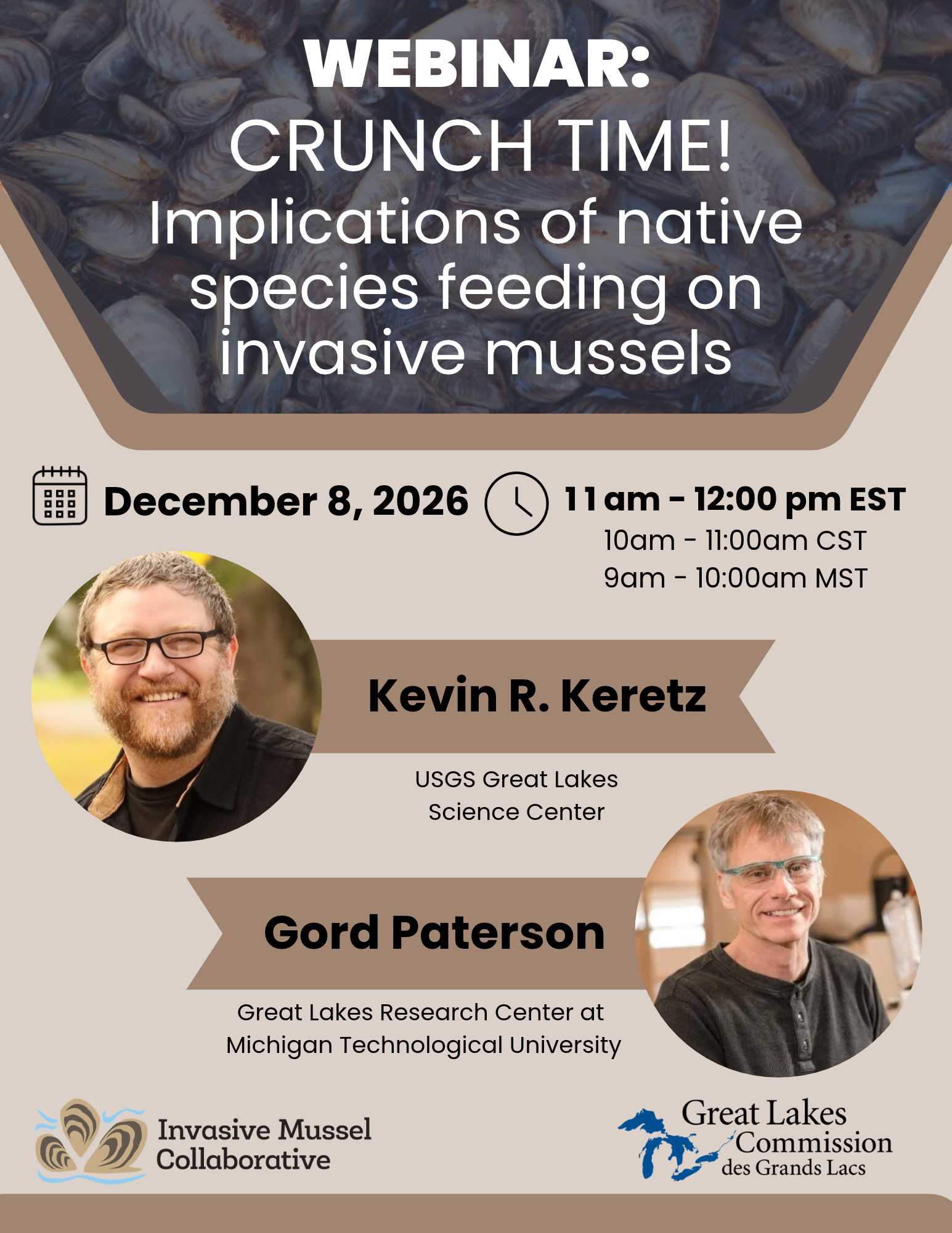
Webinar: Crunch time! – Implications of native species feeding on invasive mussels
IMC Webinar:
Crunch time! – Implications of native species feeding on invasive mussels
REGISTER HERE!

1) Predatory impact of freshwater drum on dreissenid populations in western Lake Erie – Presenter: Kevin R. Keretz, USGS Great Lakes Science Center
Impacts of dreissenid mussels (Dreissena spp.) on Great Lakes ecosystems are well documented, but the mechanisms driving variation in their abundance remain poorly understood. Dreissenid mussels have been incorporated into fish diets throughout the Great Lakes; however, studies quantifying the amount of dreissenid mussels consumed by fish predators are limited. To date, attention has mainly focused on invasive round goby (Neogobius melanostomus) predation of dreissenid mussels. Biomass of native molluscivores, namely the freshwater drum (Aplodinotus grunniens), may exceed round goby biomass by an order of magnitude in some areas. Thus, the role of predation on dreissenid mussel population dynamics may be greater than currently assumed. Here, we combine estimates of diet composition and fish biomass to estimate kg/ha of dreissenid mussels consumed by freshwater drum in the West Basin of Lake Erie. Annual consumption estimates of dreissenids by freshwater drum were large (averaging 23.79 kg/ha shell-free mass), and generally exceeded existing dreissenid consumption estimates for round goby. Our results support evaluation of ecological mechanisms, such as predation, to improve our knowledge of factors that may influence dreissenid mussel abundance.
____________________________________________________________________________________________________________________________________________________________________________

2) Tracking the nutritional quality and fate of Saginaw Bay dreissenid mussel veligers – Presenter: Gord Paterson, Great Lakes Research Center at Michigan Technological University
The introduction and establishment of dreissenid mussels into the Laurentian Great Lakes in the 1980s has resulted in significant biological and ecological change in this system. Research on dreissenid mussel effects in the Great Lakes has primarily focused on the adult life stages, with less known about the larval veliger form. Veligers range in size from approximately 70 – 200 μm with abundances in Great Lakes waters reaching 10,000’s ind./m3 during peak spawning times. This size range and abundance suggest that dreissenid veligers could represent a potentially abundant food resource for predatory zooplankton, larval fish, and planktivorous fish species. However, the nutritional quality of veligers as a food resource or the extent to which veliger production is assimilated by higher trophic level consumers remain poorly understood. This research investigated i) dreissenid veliger energy densities and fatty acid profiles as indicators of their nutritional quality and; ii) determined the fate of veliger carbon within zooplankton and bacterioplankton communities of Saginaw Bay, Lake Huron. Results of 14C labeling experiments demonstrated uptake of veliger derived organic carbon by zooplankton and bacterioplankton. Fatty acid profiles demonstrated veligers to have lower concentrations of essential polyunsaturated compounds including EPA, DHA, and α-ALA relative to bulk zooplankton. These results provide valuable information regarding veliger nutritional quality and fate of veliger production within the lower trophic levels of the Lake Huron food-web.